The 77% Green Rule: What Actually Busts the High-Density Myth at Purva Northern Lights
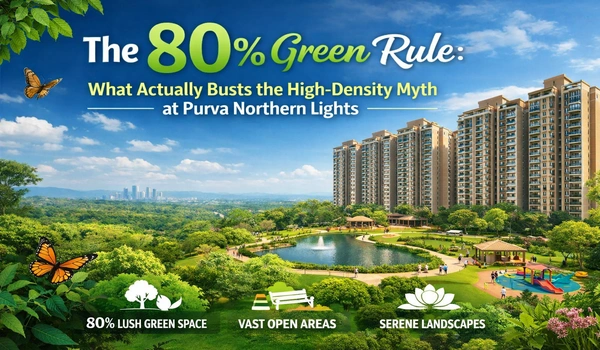
Seeing nearly 3,000 apartments and 8 towers in one project is enough to make any buyer pause. The first thought is usually: will it feel crowded? That is a fair thing to ask. But the answer does not come from the unit count alone. It comes from how the land is actually used. At Purva Northern Lights, the numbers tell a story that most buyers do not expect.
This page looks at the facts behind the density concern, one by one, and explains what the 77% open space layout actually means for daily living in KIADB Aerospace Park, Bagalur.
What "High Density" Really Means and Why Buyers Get It Wrong
Most people connect density with discomfort. They picture packed roads, full lifts, and shared amenities always in use. But density in real estate has a specific meaning. It refers to the number of homes per acre of land. A project with 500 units on 3 acres is far more dense than one with 2,973 units on 24.59 acres.
That second number is Purva Northern Lights.
When you do the math, 2,973 homes across 24.59 acres works out to roughly 121 units per acre. That is a moderate figure. Many apartment projects in Yelahanka, Hebbal, and Devanahalli pack 150 to 200 units into each acre, often on land parcels of 5 to 10 acres with far fewer shared spaces.
The myth of high density here collapses under the weight of its own numbers.
The 77% Open Space Layout: What the RERA Data Confirms
The 77% open space figure is not a marketing claim. The RERA filing for Phase 1 provides the exact area breakdown.
| Area Type | Area (sq. mt.) |
| Total Open Area | 26,314 |
| Total Covered Area (Plinth) | 12,231 |
| Total Land Area (Phase 1) | 38,545 |
The open area accounts for over 68% of Phase 1's land. When you factor in that all parking is underground across 37,055 sq. mt. of basement space, the above-ground building footprint shrinks further. The towers rise tall, but they take up a small slice of the ground.
This is not a coincidence. It is a deliberate planning choice. Building vertically means the land below stays free.
How Vertical Design Protects Ground-Level Space
There is a simple relationship between building height and ground coverage. Taller towers need less land per apartment. A 30-floor tower uses far less ground than 10 blocks of 3-floor buildings holding the same number of homes.
At Purva Northern Lights, each of the 8 towers rises to B + G + 29 or 30 floors. The Phase 1 towers reach heights of 91.3 metres and 98.95 metres. That vertical mass keeps the footprint compact.
Consider the difference this makes:
| Planning Type | Ground Coverage | Open Space |
| Low-rise, wide spread | 60 to 70% built up | 30 to 40% open |
| High-rise, vertical | 20 to 30% built up | 70 to 77% open |
| Purva Northern Lights | About 32% built up | About 68% open (Phase 1) |
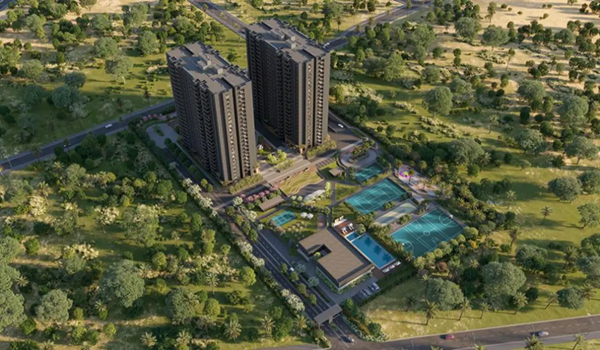
The ground that towers do not occupy becomes gardens, paths, sports zones, and breathing room. That is the 77% open space rule in practice.
Units Per Acre in Purva Northern Lights Bagalur: Phase-Wise Comparison
Looking at each phase separately gives a clearer picture of how density is distributed.
| Phase | Land Area | Total Units | Units Per Acre |
| Phase 1 | 9.5 acres | 1,225 | 129 |
| Phase 2 | 8.77 acres | 1,208 | 138 |
| Phase 3 | 6.29 acres | 540 | 86 |
| Overall | 24.59 acres | 2,973 | 121 |
Phase 3 has the lowest density of the three. Phase 2 is slightly higher than Phase 1. Across all the 3 phases, the township average stays well below the 150+ units per acre that many mid range Bangalore projects carry.
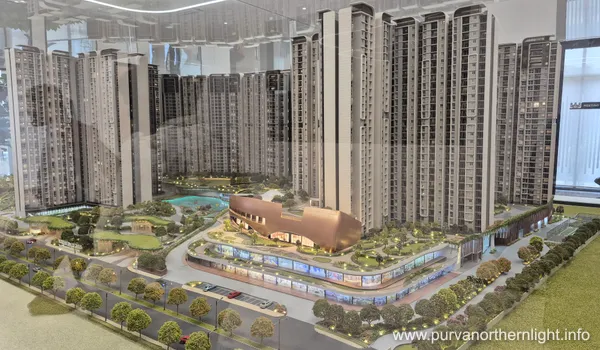
Master Plan and Tower Spacing: The Comfort You Can See
Numbers on paper are one thing. How a project feels when you walk through it is another. Tower spacing is what translates density data into lived experience.
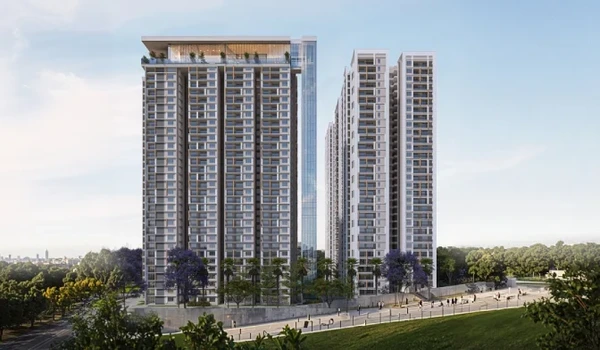
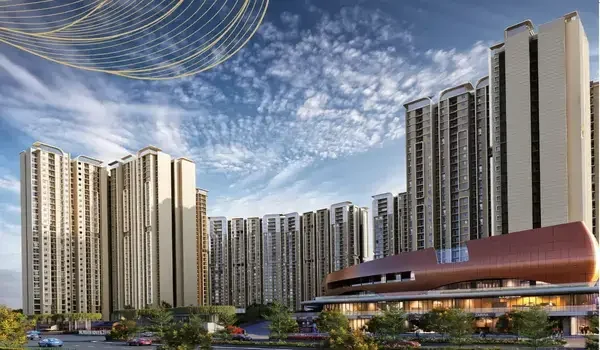
At Purva Northern Lights, the master plan places towers with clear gaps between them. They are not arranged wall to wall. This separation does several things:
- It opens up view corridors so residents see sky and greenery, not just neighbouring facades
- It allows sunlight to reach lower floors throughout the day
- It enables 270-degree cross-ventilation across most apartments
- It reduces the sense of being boxed in, even in a large community
Balconies are oriented so they do not directly face into adjacent towers at close range. This small detail makes a significant difference to how private and comfortable a home feels day to day.
Compare this with compact projects where towers are 15 to 20 metres apart. In those layouts, balconies look straight into another building, natural light is blocked on lower floors, and the ground between towers is too narrow to use comfortably. Purva Northern Lights avoids all of this through deliberate spacing in the master plan.
Air Quality and Greenery in KIADB Aerospace Park
The surroundings of a project also shape how its density is experienced. Purva Northern Lights sits inside a 3,000-acre planned industrial zone, not a congested city neighbourhood. The KIADB Aerospace Park has wider roads, lower building coverage at the macro level, and controlled land use.
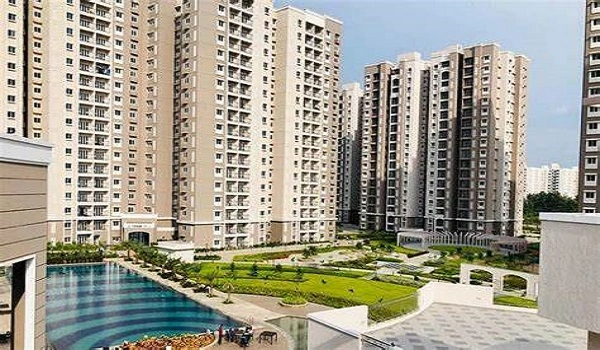
Inside the project, the landscaping follows a Bali-inspired terraced design with multi-layered botanical gardens. This kind of green cover does more than look good. It:
- Reduces the urban heat island effect within the township
- Supports better air circulation between towers
- Creates shaded zones that stay usable even in summer months
- Acts as a natural buffer between the residential and commercial areas of the park
Over 2 km of walking and jogging tracks with reflexology paths and forest fitness stations run through the open areas. This is not a token green strip along the perimeter. It is woven into the everyday movement of the project.
Purva Northern Lights Amenities and the 1 Lakh Sq Ft dual Clubhouses
One concern buyers raise about large projects is whether amenities will be overwhelmed by resident numbers. The scale of facilities here is designed to address that directly.
The dual clubhouse spans 1 lakh sq. ft. in total, split across two buildings.
- Main Clubhouse: 75,000 sq. ft.
- Secondary Clubhouse: 25,000 sq. ft.
The RERA data confirms the following amenity areas in Phase 1 alone:
| Amenity | Area (sq. mt.) |
| Clubhouse | 9,696 |
| Indoor Sports Facility | 9,696 |
| Gymnasium | 8,696 |
| Swimming Pool | 2,874 |
| Outdoor Sports Facility | 3,100 |
| Parks | 9,032 |
That is a combined amenity footprint of over 43,000 sq. mt. in Phase 1 alone. Spread across 1,225 units, this works out to over 35 sq. mt. of dedicated amenity space per apartment. Very few mid-range or even premium projects in North Bangalore come close to this ratio.
Some of the 80+ amenities include:
- Olympic-size swimming pool
- Fully equipped gymnasium and wellness zones
- Indoor courts for badminton, squash, and other sports
- Co-working spaces and banquet halls
- Pet-friendly zones and children's play areas
- Retail plaza of 76,000 sq. ft. within the township
When facilities are this large and distributed across a wide site, crowding at peak hours is far less likely.
Luxury Low-Density Townships in North Bangalore: Where Does This Project Stand?
North Bangalore has seen a sharp rise in large-format township projects since 2022. Not all of them use land well. Here is how the key metrics compare.
| Project Type | Land Area | Units | Units Per Acre | Open Space |
| Typical compact project | 5 to 8 acres | 500 to 800 | 90 to 160 | 30 to 40% |
| Large township average | 15 to 25 acres | 1,500 to 3,000 | 100 to 150 | 50 to 70% |
| Purva Northern Lights | 24.59 acres | 2,973 | 121 | 77% |
The 77% open space target places this project at the higher end of what township planning in North Bangalore currently delivers. It is not average. Most comparable-scale projects in Devanahalli and Bagalur do not exceed 65 to 70% open space.
What This Means for Daily Life
Abstract numbers need to translate into something real. Here is what the density and open space data means on an ordinary day for a resident:
- You step out of your apartment and have 2 km of walking track available before you reach a gate
- Your balcony has an unobstructed view rather than a wall 15 metres away
- The gym and pool are sized for a community of nearly 3,000 families, not 300
- Your child's play area is part of 9,000+ sq. mt. of park space, not a small patch between towers
- The air moves through open corridors because towers are spaced and oriented for cross-ventilation
None of this happens by accident. It is the result of planning a large land parcel with ground coverage as a priority rather than an afterthought.
Frequently Asked Questions:
Q1. Is Purva Northern Lights actually a high-density project?
At 121 units per acre, it sits at a moderate density level. Many projects in North Bangalore and central Bangalore run higher. The 77% open space layout means the ground remains largely open despite the total unit count.
Q2. What does 77% open space mean in practice?
It means roughly 77% of the 24.59 acre land area is not built up. That space is used for gardens, walking tracks, sports areas, and green buffers between towers.
Q3. How are the towers spaced in the master plan?
Towers are placed with clear gaps between them and oriented to allow cross-ventilation and open view corridors. Balconies are not directly facing adjacent towers at close range.
Q4. Will amenities feel crowded with nearly 3,000 families?
The 1 lakh sq. ft. dual clubhouse and 80+ amenities are sized for the full township population. Phase 1 alone has over 43,000 sq. mt. of dedicated amenity space across 1,225 units, which is a strong ratio by any standard.
Q5. How does this project compare to other townships in Bagalur and Devanahalli?
Most comparable projects in the area achieve 50 to 70% open space. At 77%, Purva Northern Lights is at the higher end of the range for North Bangalore township planning.
Q6. Does high-rise living feel claustrophobic here?
Vertical towers with proper spacing tend to feel more open than low-rise buildings packed side by side. The tower placement at Purva Northern Lights is designed to maximise light, air, and view from each apartment.
Q7. Is KIADB Aerospace Park itself a crowded area?
No. The park spans 3000 acres of planned industrial and residential land with wide internal roads and controlled development. It is significantly less congested than established residential zones in Yelahanka, Hebbal, or the Central Bangalore ring.
Q8. Does the open space ratio affect long-term property value?
Yes. Projects with higher open space ratios and lower ground coverage tend to hold buyer appeal longer.